Thursday, 25 November 2010

S. Korean defense minister resigns; North threatens additional attacks


South Korean Defense Minister Kim Tae-young resigned Thursday, according to the South Korean presidency, two days after North Korea shelling left four South Koreans dead.
"The president has just accepted the defense minister's resignation," according to a spokesman for the Presidential Blue House.
Kim, a former general, came under heavy criticism after the March sinking of the South Korean war ship Cheonan and again after North Korea struck the South's Yeonpyeong Island on Tuesday.
North Korea has been blamed by the South and other nations for the Cheonan incident, in which 46 sailors were killed, but has denied responsibility. North Korea has blamed South Korea and the United States for the Yeonpyeong incident, in which two South Korean marines and two civilians were killed and 15 others injured.
South Korean lawmakers from both parties alleged that South Korean forces were unprepared for the North Korean attacks, and some have insisted that South Korean aircraft should have responded to the Yeonpyeong incident immediately. Lawmakers demanded Kim's resignation earlier Thursday.
Kim actually submitted his resignation May 1, after the Cheonan incident, said the Blue House spokesman, but it was not accepted until Thursday because of the Cheonan aftermath and other military-related issues. The Cheonan sinking sparked a public uproar, with many stating that it should not have been possible for North Korea to have damaged South Korea's military, which is much more high-tech.
President Lee also drew criticism for his first statements after the Yeonpyeong artillery bombardment, in which he asked for a stern response but added that de-escalatory measures also had to be taken. Later that same day, Lee spoke to the military and urged heavy retaliation.
It was unclear who advised Lee on his first message, but on Wednesday, speaking to a lawmakers' committee, Kim said the president's first instruction was to stop the fire from spreading.
A new minister is expected to be appointed soon.
State-run North Korean broadcaster KCTV reported Thursday that South Korea had stated its plan to "fire towards our territorial waters with their Yeonpyeong-based artillery on November 22." The North said it asked "the puppet South" not to do so, but it persisted, and the North fired back in self-defense.
"If the U.S. truly wishes to ease the tension in the Chosun [Korean] peninsula, rather than protecting the puppet South, they should control the South, so the South will not hang on to maintaining the NLL [Northern Limit Line] by invading territorial waters and firing artilleries," KCTV said. "This incident shows that the acutal offender of the armistice is the puppet South and it is the U.S. which created tension in the Chosun west sea."
Earlier Thursday, state media said North Korea will launch additional attacks on South Korea if the South continues "reckless military provocation."
Pyongyang "will deal without hesitation the second and third strong physical retaliatory blow" if provoked, its KCNA news agency said.
As an example of provocation, it indirectly referred to a military drill that South Korea and the United States plan to hold in the Yellow Sea starting Sunday.
Meanwhile, South Korea said Thursday that it will strengthen and supplement its rules of engagement in the Yellow Sea, following the incident on Yeonpyeong Island.
South Korea was holding annual military exercises near North Korea when Pyongyang started shelling Tuesday. Shells from the South's exercises landed in North Korean waters, KCNA said.
KCNA on Thursday continued its verbal offensive against the South Korean-U.S. military drill.
"The U.S. and the South Korean puppet forces are foolishly contemplating an additional provocation aimed to orchestrate another farce and charade such as the 'Cheonan' case while kicking up rows and holding confabs one after another such as the declaration of a 'state of emergency' and 'a meeting of ministers in charge of security,' far from drawing due lesson from the recent shelling," KCNA said.
The aircraft carrier USS George Washington on Wednesday sailed toward the Yellow Sea for the drill, which was billed as defensive.
"It is a long-planned exercise," said Adm. Mike Mullen, chairman of the U.S. Joint Chiefs of Staff.
"That said, it is meant to send a very strong signal of deterrence and also work with our very close allies in South Korea," Mullen said on CNN's "Fareed Zakaria GPS."
"We're very focused on restraint -- not letting this thing get out of control. The South Koreans so far have responded that way. Nobody wants this thing to turn into a conflict."
On Thursday morning, Lee and his economic and security ministers met in Seoul.
The meeting began with a moment of silence for the Yeonpyeong victims. After the meeting, South Korea said it would boost its rules of engagement in the Yellow Sea.
South Korean marine forces based in five islands near North Korea and the disputed Northern Limit Line also will be reinforced, a government spokesman said.
The tense maritime border between the two Koreas has become the major military flash point on the Korean peninsula in recent years.
The Yeonpyeong attack also will lead to a plan for civilian safety on the five islands in the Yellow Sea, the government spokesman said. No details were immediately offered about the plan, but Lee on Wednesday ordered the strengthening of civilian shelters on the islands.
The islands include Yeonpyeong and Baengnyeong, off which the South Korean warship Cheonan was sunk in March, killing 46 sailors. Seoul blamed Pyongyang for the torpedo attack, which the North has denied.
The Lee administration also will continue to closely monitor capital markets and foreign exchange rates, prepared to take preventative measures as needed, the spokesman said. The Yeonpyeong shelling sent ripples through South Korea's stock market, which has rebounded.
South Korea's economic and security ministries will cooperate closely, and the administration will publicize developments in real time to address major concerns and squelch rumors, the spokesman said.
The Yeonpyeong attack was the first direct artillery assault on South Korea since the Korean War ended in 1953.

Source: CNN

North Korea's military aging but sizable

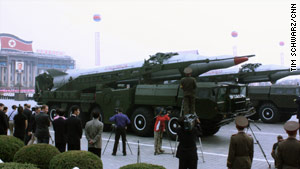
It's a bit like train-spotting but rather more serious. On October 10, Korea-watchers pored over live televised coverage of a massive military parade in Pyongyang, held to mark the 65th anniversary of North Korea's ruling party. Just like the Soviet parades of yore, it was a chance to see what military hardware the North might be showing off.
The official news agency said the parade showed "the will and might of Songun Korea to wipe out the enemy." The hardware was accompanied by slogans such as "Defeat the U.S. Military. U.S. soldiers are the Korean People's Army's enemy." And besides the incredible synchronized goose-stepping, there were tanks and new missiles.
Analysts paid special attention to the first public appearance of a road-mobile ballistic missile with a projected range of between 3,000 and 4,000 kilometers (roughly 1,900 to 2,400 miles), though reports of its existence had circulated for several years. There was also a new version of the No-dong ballistic missile, with a tri-conic nosecone, on show. That led Aviation Weekly and others to observe design similarities to Iran's Shahab missiles, suggesting further military cooperation between the two governments.
North Korea's nuclear capability and ballistic missile technology are its trump card, to make up for its aging conventional forces and as a bargaining chip in negotiations. So that's what receives the bulk of funding and expertise. But despite economic stagnation, technological limitations and international sanctions, its conventional forces can't be discounted, if only because of their size.
According to South Korean analysts, the North scraped together what little foreign exchange it had to buy $65 million of weapons from China, Russia and eastern Europe between 2002 and 2008. One example: It appears to have bought Chinese-made ZM-87 anti-personnel lasers, using one to "illuminate" two U.S. Army Apache helicopters flying along the southern side of the Demilitarized Zone in 2003. None of the crew members was injured.
China says it continues to be open to military collaboration with Pyongyang and last month welcomed a senior North Korean official to Beijing to "enhance coordination of the two militaries." China is thought to have supplied the North with multiple rocket launchers and spare parts for planes, among other equipment. Pyongyang has also turned to Iran and Egypt for military transfers.
Much of the North's hardware is locally built using Chinese and Russian templates. It has begun deploying a new tank, called the P'okpoong (Storm), which is modeled on the Russian T-62 tank but hardly a match for modern U.S. battle tanks. It's not clear how many of these are in service, but Jane's Armed Forces Editor Alexander von Rosenbach says it is thought that only a few have been delivered -- and they lack devices like thermal imaging sights.
Also on show at the October parade: a new surface-to-air missile similar to a Chinese model. Jane's concluded that it represented "a major expansion in North Korea's air defense potential," with a radar/guidance system that would be harder to jam. And although little is known about the size and scope of the North's artillery, the barrage fired this week at Yeonpyeong Island suggests that it can't be ignored.
The North Korean regime has also devoted great resources to developing its navy, not with battleships but fast-attack vessels and an array of submarines. Jane's estimates that it has more than 400 surface vessels. And it is not hesitant to use its maritime forces, as demonstrated by the sinking of the 1,200-ton South Korean corvette Cheonan by a torpedo in March. But in a confrontation, the South Korean navy is likely to come off best, as happened in a firefight in 1999.
The main weakness of the North's military is a chronic shortage of computers, modern command and control and electronic warfare assets -- in other words, much of what makes up the 21st-century battlefield. At the same time, South Korea has used its economic strength to modernize its armed forces: for example, building three $1 billion Aegis-class destroyers to counter ballistic missiles.
The same applies in the air. North Korea's air force largely comprises aging Soviet MiG fighters (though it has some MiG 29s) that would be unable to compete with South Korean F-15 jets or the F-16 fighters of the U.S. 7th Air Force, based in South Korea. In addition, the North's air force has suffered fuel shortages, and Jane's estimated that the North's fighter pilots may get as little as 25 flying hours per year. The North Koreans also have a large fleet of Russian-design biplanes that would be better suited to crop-spraying but could be used to drop special forces behind enemy lines in the event of conflict.
To compensate for obsolescence, the North deploys boots on the ground in great numbers. Jane's estimates that its standing army numbers just over 1 million personnel, with reserves estimated at more than 7 million. But North Korean soldiers are poorly fed, according to analysts and reports from defectors, and rarely train due to scarcity of fuel and ammunition
Despite the size of its armed forces, few analysts expect that the regime in the North would want to launch a general assault on the South, knowing that it would probably be repulsed and that in turn would imperil the regime. It might also ignite dissent.
"With the ongoing leadership transition in North Korea, there have been rumors of discontent within the military, and the current actions may reflect miscommunications or worse within the North's command-and-control structure," geopolitical risk analysis firm Stratfor says.
There is another practical reason why a land invasion would be difficult. South Korea has built an array of obstructions on roads from the North that would force an invader's tanks off the pavement and into rice fields. Only in the winter would those fields be hard enough to allow the tanks to cross them.
Short of a general assault, the North clearly has enough in its arsenal to cause damage and death to its adversary, as the torpedo attack in March and the barrage this week have shown. And it has thousands of artillery pieces close to the Demilitarized Zone, which is just 30 kilometers (18 miles) from Seoul. Recent events show that it is also quite ready to exploit the element of surprise.
There remains the great unanswered question about intentions. There's plenty of what one expert calls "echo chamber analysis." But as former President Carter wrote with a hint of understatement in the Washington Post on Wednesday: "No one can completely understand the motivations of the North Koreans."

Source: CNN